
Tag: Sam Vaknin

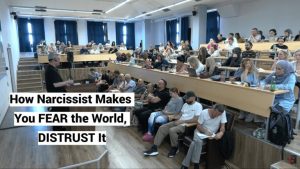
How Narcissist Makes You FEAR the World, DISTRUST It (Clip: Skopje Seminar, Day 2, Lecture 4)

Healing from narcissistic abuse is a complex journey that involves reclaiming one’s perception of reality, rebuilding trust, and restoring self-worth. Scientific studies provide a solid foundation to understand the damage caused and pathways for recovery. By rejecting the narcissist’s distorted narratives and embracing empowering affirmations rooted in evidence, survivors can move toward a healthier, more autonomous life. How Narcissist Makes You FEAR the World, DISTRUST It (Clip: Skopje Seminar, Day 2, Lecture 4)


Read More »

Surprising Truths About Smear Campaigns: Structure, Membership, Dynamics

Smear campaigns are sophisticated psychological weapons wielded by disturbed individuals to manipulate, destroy, and control. Understanding their structure, motivations, and dynamics is crucial for anyone who may encounter or be targeted by such attacks. Awareness can empower victims, inform public discourse, and guide legal and social responses to mitigate harm.
Dr. Sam Baknin’s expert insights provide a vital framework for decoding the dark psychology behind smear campaigns, highlighting the importance of vigilance and critical thinking in an era where reputation can be weaponized with alarming ease. Surprising Truths About Smear Campaigns: Structure, Membership, Dynamics

Read More »

Self-analysis or Rumination? (FREE Seminar in Description)

Differentiating silent treatment from no contact and rumination from self-analysis is vital for emotional health and effective communication. Silent treatment is a harmful behavior, while no contact is a healthy boundary. Rumination traps you in the past, whereas self-analysis empowers transformation.
By mastering these distinctions and applying the simple tests outlined, you can foster healthier relationships with others and yourself, leading to clearer thinking, emotional resilience, and a more fulfilling life journey. Self-analysis or Rumination? (FREE Seminar in Description)

Read More »

How Witnessing a Trauma Can Traumatize YOU (Vicarious Traumatization and Moral Injury)

Vicarious traumatization and moral injury highlight the profound psychological consequences of witnessing trauma and injustice. Understanding these phenomena is vital for mental health professionals, first responders, and anyone exposed to distressing events indirectly. Recognizing the signs, seeking support, and taking proactive steps can help mitigate the far-reaching effects of trauma that extend beyond direct victims.
By fostering awareness and compassion, society can better support those grappling with the invisible wounds of trauma and moral injury, ensuring that the ripple effects do not cause further harm. How Witnessing a Trauma Can Traumatize YOU (Vicarious Traumatization and Moral Injury)

Read More »

Mindblindness: Mental Maps, Attachment Styles, Internal Working Model (IWM)

The intricate system of mental maps and models shapes our understanding of ourselves and others. The internal working model of attachment, rooted in early experiences and theory of mind development, profoundly influences how we relate to people throughout life. By grasping these concepts, we unlock deeper insights into human behavior, identity, and the foundations of healthy relationships. Mindblindness: Mental Maps, Attachment Styles, Internal Working Model (IWM)

Read More »

Collective Narcissism and Its Leaders: Case of Macedonia (with Nikola Ristevski)

This illuminating conversation blends science, psychology, culture, and politics to offer a comprehensive outlook on Macedonia’s challenges and opportunities. It stresses the power of language, time, and collective consciousness in shaping reality and identity.
Macedonia stands at a crossroads: the path toward economic diversification, intellectual leadership, national cohesion, and creative expression offers hope for transformation. However, this requires courage to confront harsh realities, the creation of new parallel structures, and the rekindling of dreams and poetry in public life.
With its rich cultural heritage, resilient people, and strategic geographic position, Macedonia holds the promise of becoming a vibrant, innovative nation. The future depends on nurturing leadership that balances vision with emotional maturity and cultivating a society united by shared goals and inspired by creativity. Collective Narcissism and Its Leaders: Case of Macedonia (with Nikola Ristevski)

Read More »

Overcome Narcissist Aftermath: Your Grief is Shared Fantasy, too!

Recovering from narcissistic abuse grief requires understanding the complex fantasy dynamics that bind you to your abuser and yourself. By recognizing how the shared fantasy distorts reality and identity, you gain the power to dismantle it.
The journey through denial, anger, bargaining, depression, acceptance, and finally hope is neither linear nor easy but is essential for reclaiming your true self. With self-compassion, support, emotional honesty, and time, you can move beyond the shadow of the narcissist and create a fulfilling, authentic future.
Remember, healing is a process, not a destination. Be patient and gentle with yourself as you transform grief into growth. Overcome Narcissist Aftermath: Your Grief is Shared Fantasy, too!

Read More »

Is It Natural to Kill Our Parents? Dark Psychology of Parricide (with Maureen Callahan, The Nerve)

Parricide is a rare but deeply disturbing act that challenges our understanding of family, identity, and human nature. Far from being simply a shocking headline, it is rooted in complex psychological, social, and evolutionary factors. Recognizing these dynamics is essential not only for comprehending such tragedies but also for prevention and healing.
By exploring parricide through historical, psychological, and familial lenses, we gain a deeper understanding of the dark, often invisible struggles within families. This knowledge urges us to look beyond sensational headlines and reflect on the profound human pain that underlies such acts — a pain that demands empathy, attention, and action. Is It Natural to Kill Our Parents? Dark Psychology of Parricide (with Maureen Callahan, The Nerve)

Read More »

Narcissism and Vicarious, Simulated Life

Vicarious experience is a powerful and often underappreciated mechanism by which humans learn, adapt, and emotionally fulfill themselves. Whether through games, crime fascination, activism, affairs, or even narcissism, these simulated experiences offer a risk-free way to prepare for life’s uncertainties and complexities.
Rather than viewing vicarious experience as mere fantasy or avoidance, recognizing its role in mental simulation and emotional preparation helps us understand human behavior more deeply. Embracing these experiences mindfully can enhance resilience, empathy, and personal growth in an unpredictable world. Narcissism and Vicarious, Simulated Life

Read More »

Infidelity as Shared Fantasy

Infidelity and love affairs are multifaceted phenomena revealing much about human psychology:
They expose the interplay between self-identity, emotional needs, and relational dynamics.
Shared fantasies and infidelity serve as coping mechanisms for unmet needs and unresolved childhood conflicts.
Cheating is often a symptom of deeper issues—immaturity, lack of emotional resources, and failure to process distress constructively.
Understanding these dynamics can foster empathy and guide healthier relationship practices. Infidelity as Shared Fantasy

Read More »