

Category: Summaries

Control Freaks and Their Victims

Sam Vaknin distinguishes control from manipulation, power plays, and sadomasochism, arguing that control focuses on securing people as sources of outcomes and is largely unconscious. He outlines controller motivations—narcissistic grandiosity and separation/abandonment insecurity—and techniques such as withholding information, intimidation, disorientation (e.g., gaslighting), and expectation-broadcasting. He also explains why some people collude with controllers—seeking a secure base, embracing a victim identity, or validating internalized self-derogation—and describes collusive tactics like ostentatious helplessness, bottom-up control, and inducing unpredictability to provoke micromanagement. Control Freaks and Their Victims


Read More »

Narcissistic Abuse is Grueling TEST: Did YOU Pass It? (Clip: Skopje Seminar, May 2025)

The speaker explains how narcissists idealize others by imposing a shared fantasy and using love bombing to make victims fall in love with an inflated, mirror-like image of themselves. This creates a dual mothership dynamic where the victim becomes both mother and child to the narcissist, producing an intense, enmeshed attachment that reproduces early developmental failures in separation-individuation. The narcissist then tests the victim’s maternal devotion through escalating abuse to determine whether the victim will remain, enabling the narcissist’s attempted individuation and continued control. Narcissistic Abuse is Grueling TEST: Did YOU Pass It? (Clip: Skopje Seminar, May 2025)

Read More »

Narcissist’s Seductive Hyperreality: Feminine Sign-value of False Self (Baudrillard)

Lecturer applies Baudrillard’s spectacle theory to pathological narcissism, arguing that in postmodern hyper-simulation identities are performative and constructed from the sign-value of possessions and curated images. Narcissism acts as a defensive, preemptive objectification in which the false self replaces the authentic self, broadcasting superiority and seducing others into a fabricated reality. Unlike psychopathy’s direct destruction of external reality, narcissism subverts it through mimicry, seduction, and the reproduction of simulations—phenomena amplified by social media and consumer culture. Narcissist’s Seductive Hyperreality: Feminine Sign-value of False Self (Baudrillard)

Read More »

No Contact with NON-abusive Parents, Family? (The Nerve with Maureen Callahan)

Professor Sam Vaknin discussed the distinction between legitimate no-contact as a response to abuse and estrangement driven by narcissism, atomization, and hypervigilance, arguing that many who cut family ties for minor disagreements are enacting a form of externalized aggression. He explained how projected splitting, projection, and projective identification in dysfunctional parents create the golden child and scapegoat roles, which often persist into adulthood and shape sibling dynamics and identity. Vaknin recommended reconstruction and integration over permanent estrangement—advocating empathy, realistic understanding of parental limitations, and reconciliation where possible, while acknowledging exceptions for genuine abuse. No Contact with NON-abusive Parents, Family? (The Nerve with Maureen Callahan)

Read More »

Witnessing the Narcissist: Need to be Remembered, Validated

Sam Vaknin explains that the human need to be seen—rooted in early survival—is lifelong and evolves into a need for witnessing, where others not only remember events but agree with one’s interpretation, shaping self-concept. He contrasts healthy witnessing, which supports a stable, autonomous self, with pathological witnessing in narcissism, where a fragmented self relies entirely on external witnesses, leading to vulnerability and psychopathology. He warns that modern isolation and declining social witnessing threaten mental health broadly, potentially causing widespread disorders as people lose the external scaffolding that sustains identity. Witnessing the Narcissist: Need to be Remembered, Validated

Read More »

Narcissist, Psychopath: My Way or Highway, Eff You, In Your Face Factor

The speaker distinguishes independence (healthy ego and boundary maintenance with cooperative engagement) from defiance (exclusionary, antagonistic withdrawal), and maps a spectrum of reactant defiance from ostentatious eccentricity through nonconformity and consummacious rejection of authority to active rebelliousness and crime. 2) Narcissists and psychopaths use defiance—driven by traits like dissociality and antagonism—as a pride-infused, anxiolytic strategy to signal superiority and maintain fragile self-concepts, often frustrating others and treating people as disposable investments. 3) These defensive, disinhibitory strategies are ultimately self-defeating: reality breaches their defenses, leading to collapse, social isolation, substance use, emotional dysregulation, and sometimes suicide, leaving no sustainable legacy. Narcissist, Psychopath: My Way or Highway, Eff You, In Your Face Factor

Read More »

How to Reboot Your Life In 2026

Sam Vaknin presents a practical guide to “rebooting your life” focused on self-reliance, honest self-appraisal, and rebuilding a coherent personal narrative that integrates past and present. Key recommendations include cultivating authentic self-love and assertiveness (not aggression), establishing internal boundaries, listening more than speaking, surrounding yourself with mentors, embracing losses and novelty while linking the new to the old, and aiming for “good enough” rather than perfection. The overall aim is not to become a different person but to become your true self through wisdom, verification before trust, and ongoing integration of experience. How to Reboot Your Life In 2026

Read More »

How To Recognize Covert/Collapsed Personality Disorders

Sam Vaknin argued that many personality disorders — especially Cluster B (narcissistic, borderline, histrionic, antisocial) — reflect a single underlying disorder characterized by confusion between internal and external objects, with individuals transitioning between overt, collapsed, and covert states driven by narcissistic gaps and mortification. He described covert, collapsed, and overt presentations and outlined five covert narcissist solutions (delusional narrative, antisocial, paranoid/schizoid, paranoid-aggressive/explosive, masochistic/avoidant), extending similar state models to borderline, histrionic, and antisocial presentations. He concluded that diagnostic categories are overly fragmented and advocated for a parsimonious, dynamic model unifying these disorders while directing viewers to detailed videos and literature for deeper study. How To Recognize Covert/Collapsed Personality Disorders

Read More »

Psychopaths, Narcissists Rage Differently, for Different Reasons

The speaker distinguishes narcissistic rage from psychopathic rage, explaining that narcissistic rage is reactive, short-lived, ostentatious, and serves as self-regulation to restore grandiosity, while psychopathic rage is goal-oriented, instrumental, and often driven by frustration. Narcissistic rage stems from internal conflicts between feelings of unworthiness and grandiosity, negates intimacy, and can escalate into borderline-like dysregulation or psychotic micro-episodes. The talk also situates narcissistic rage within broader frameworks of grief, depression, and psychopathology, proposing that grandiosity functions as a compensatory defense against inner despair. Psychopaths, Narcissists Rage Differently, for Different Reasons

Read More »

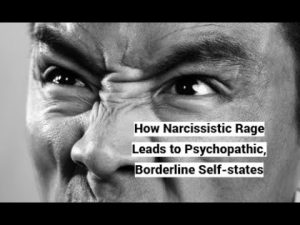
How Narcissist’s Rage Leads to Psychopathic, Borderline Self-states (Clip Narcissism Summaries)

Narcissists under stress can shift into borderline states with emotional dysregulation and, if frustration persists, transition into a psychopathic state characterized by cold, premeditated, and potentially violent behavior. They perceive others as internal objects, respond to frustration with covert planning and externalized aggression (coercive snapshocking, projective identification, aloplastic defenses) to force compliance or destroy the perceived source of threat, often hiding intentions during a seemingly normal covert phase. Intimacy increases vulnerability to abuse, and narcissistic collapse following failure can lead to severe depressive, substance-use, and presychotic deterioration. How Narcissist’s Rage Leads to Psychopathic, Borderline Self-states (Clip Narcissism Summaries)

Read More »