

Category: Summaries

Narcissism and Vicarious, Simulated Life

Vicarious experience is a powerful and often underappreciated mechanism by which humans learn, adapt, and emotionally fulfill themselves. Whether through games, crime fascination, activism, affairs, or even narcissism, these simulated experiences offer a risk-free way to prepare for life’s uncertainties and complexities.
Rather than viewing vicarious experience as mere fantasy or avoidance, recognizing its role in mental simulation and emotional preparation helps us understand human behavior more deeply. Embracing these experiences mindfully can enhance resilience, empathy, and personal growth in an unpredictable world. Narcissism and Vicarious, Simulated Life

Read More »

Infidelity as Shared Fantasy

Infidelity and love affairs are multifaceted phenomena revealing much about human psychology:
They expose the interplay between self-identity, emotional needs, and relational dynamics.
Shared fantasies and infidelity serve as coping mechanisms for unmet needs and unresolved childhood conflicts.
Cheating is often a symptom of deeper issues—immaturity, lack of emotional resources, and failure to process distress constructively.
Understanding these dynamics can foster empathy and guide healthier relationship practices. Infidelity as Shared Fantasy

Read More »

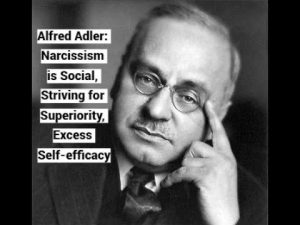
Adler: Narcissism is Social, Striving for Superiority, Excess Self-efficacy (Contra Freud)

Alfred Adler’s Individual Psychology represents a transformative chapter in the history of psychology. His integration of biological, psychological, and social factors created a holistic framework that challenged Freud’s psychoanalysis and paved the way for modern psychological thought. By emphasizing social interest, free will, and the universal experience of inferiority, Adler offered a hopeful, pragmatic, and deeply humanistic vision of mental health and personal development. Adler: Narcissism is Social, Striving for Superiority, Excess Self-efficacy (Contra Freud)

Read More »

Recovery’s Uneven Path: Setbacks, HOPE after Narcissistic Abuse (Skopje Seminar, Day 2, Lecture 3)

Recovering from narcissistic abuse is akin to regaining lost physical and psychological faculties after severe trauma. Victims often find themselves regressed to infancy, needing to rebuild their relationship with their body and mind piece by piece.
By fostering attention, regulation, and protection of the body, shedding victimhood mentality, and cultivating authenticity, positivity, and mindfulness in the mind, survivors can embark on a transformative path toward healing.
This holistic approach empowers victims to become allies with their bodies and minds, reclaim their identities, and ultimately break free from the cycles of abuse and victimization. Recovery’s Uneven Path: Setbacks, HOPE after Narcissistic Abuse (Skopje Seminar, Day 2, Lecture 3)

Read More »

Narcissism: Heredity, Overt-Covert Genders, Confabulation, and Elephants

Understanding narcissism and animal behavior requires a critical mindset that separates ideology from evidence. Narcissistic Personality Disorder is a nuanced condition influenced more by environment than heredity, with gender differences in how it manifests. Similarly, elephant behavior defies simplistic, idealized portrayals, revealing a complex social structure rife with conflict.
For both psychology and ethology, acknowledging complexity and avoiding oversimplification leads to better knowledge and more effective interventions, whether in clinical settings or wildlife conservation. Narcissism: Heredity, Overt-Covert Genders, Confabulation, and Elephants

Read More »

Epstein: Depravity as Rebellion, Psychopathic Liberty, Defiant Freedom

Understanding psychopathy and narcissism through the lenses of deristic thinking, control, and freedom provides valuable insights into why these individuals behave as they do. Their rejection of societal norms is not mere rebellion but a complex psychological strategy to cope with deep anxiety and a perceived lack of liberty. Recognizing these dynamics helps in developing better psychological frameworks and interventions that address the root causes of their behaviors rather than simply condemning their actions. Epstein: Depravity as Rebellion, Psychopathic Liberty, Defiant Freedom

Read More »

Narcissist: I Never Fail, Defeat Not an Option

Narcissists experience failure as a threat to their very existence but simultaneously use it as a tool for self-enhancement. Their coping strategies—ranging from grandiose reframing and victimization to emotional detachment and devaluation—reveal a fragile psyche desperately protecting a false self. Understanding these mechanisms not only illuminates narcissistic behavior but also helps in managing relationships and interactions with narcissistic individuals. Narcissist: I Never Fail, Defeat Not an Option

Read More »

Why Some People Are Instantly Disliked?

Being instantly disliked is a multifaceted phenomenon rooted in a blend of personal traits, social behaviors, unconscious psychological processes, and evolutionary biology. It involves memory triggers, projection, violation of social norms, unpredictability, and nonverbal communication mismatches.
Understanding these dynamics can foster empathy toward those who are often rejected and help us reflect on our own instantaneous judgments. While some people may struggle to connect socially due to these factors, awareness and intentional effort can sometimes bridge the gap between rejection and acceptance. Why Some People Are Instantly Disliked?

Read More »

Post-TRAUMA: Expelled from Narcissist’s Shared Fantasy (Skopje Seminar Day 2, Lecture 2, May 2025)

Narcissistic abuse is a unique and devastating form of trauma that entails profound identity loss, grief, and a complex cycle of emotional manipulation. The victim’s journey is marked by the shattering of illusions, betrayal, and a crisis of meaning that permeates every aspect of their existence. Recovery is neither simple nor quick; it demands a nuanced understanding of the psychological dynamics at play and a comprehensive healing strategy addressing body, mind, and functional restoration.
While the path to healing is challenging, embracing an internal locus of control and engaging in holistic recovery methods can restore the victim’s autonomy, identity, and hope for a fulfilling life beyond narcissistic abuse. Post-TRAUMA: Expelled from Narcissist’s Shared Fantasy (Skopje Seminar Day 2, Lecture 2, May 2025)

Read More »

Siblings and Parents Shape YOU Equally

The development of children is shaped by a dynamic and complex web of influences. While genetics play a significant role, the family environment—especially sibling relationships and birth order—critically affects personality formation and mental health. Parents and siblings contribute uniquely and interactively, with sibling competition, collaboration, and emergent roles deeply influencing children’s trajectories.
Understanding these dynamics can help relieve parental guilt, clarify the origins of psychopathology, and inform better family support strategies. Future research integrating genetics and environmental factors offers hope for unraveling these mysteries and improving developmental outcomes for all children. Siblings and Parents Shape YOU Equally

Read More »